
Module 2, lesson 3
Your Next Move: Finding and Applying to the Right Opportunities
Let’s get real, sometimes what holds us back from taking the next step in our professional journeys is simply not having the resources to pursue them. But, as aspiring CMP professionals, managing your resources isn’t always about budgeting your finances; it’s also about learning how to expand your opportunities and your susceptibility to receiving them. This lesson will be your guide on finding grants and other avenues to help propel your career and ideas forward.
objectives
- Understand the different funding and career development opportunities that best fit your circumstances
- Be aware of the different types of organizations that support young professionals
- Learn how to prepare application letters and proposals
Understanding the What
The journey to unlocking opportunities for yourself starts with understanding what you’re looking for. Today, various organizations and institutions offer support to young creatives and cultural entrepreneurs. Let’s go through some common funding opportunities found in the Philippines, and their distinct characteristics:
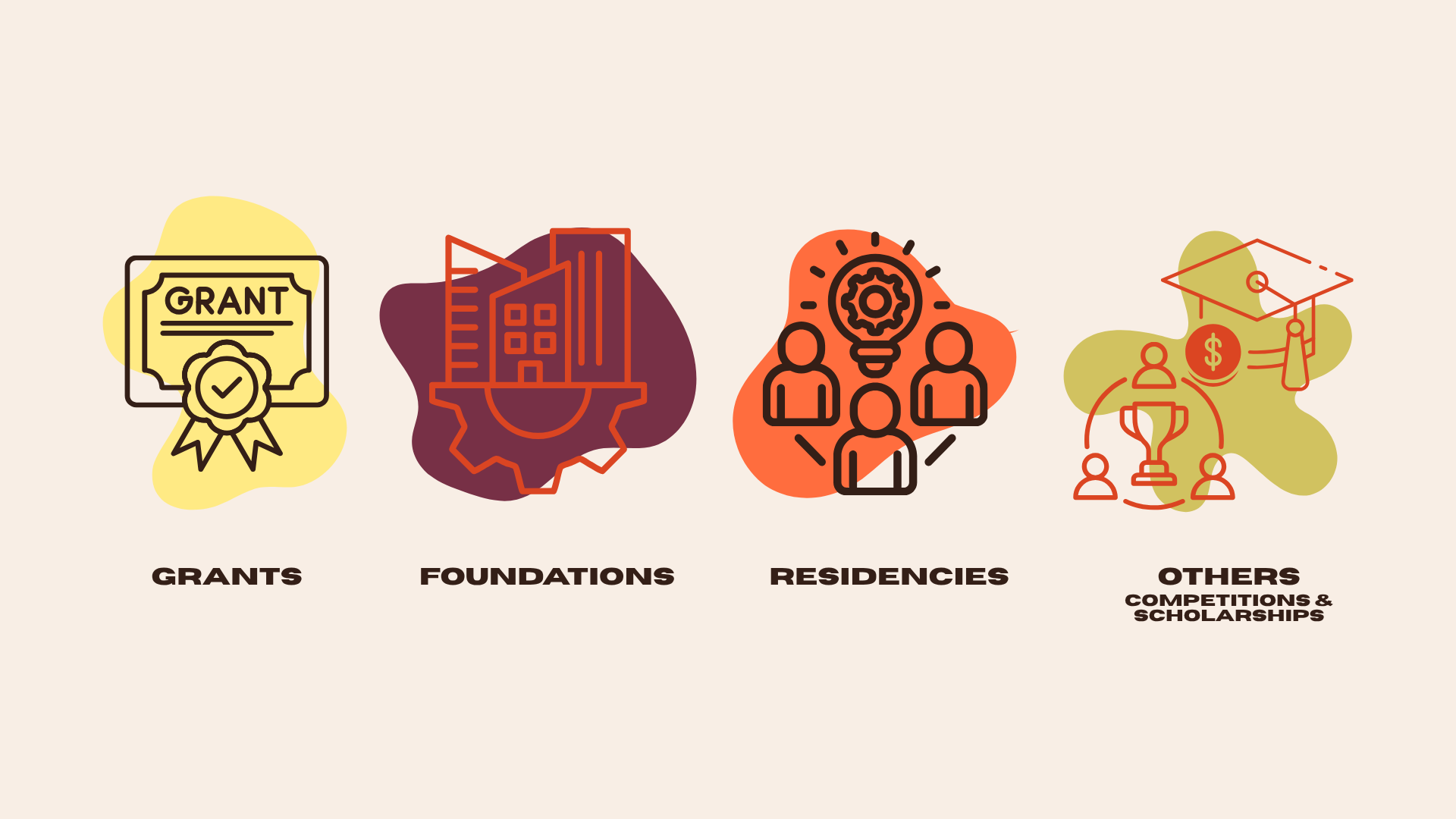
Grants
Grants are direct financial awards provided to individuals or organizations to fund specific creative projects or initiatives. It’s essentially a broader term used for any organization that provides grants. Grants often require specific documents–usually a detailed proposal and budget–and their benefits include not only funding but also validation and increased credibility, which can open doors for further opportunities.
Now you may wonder, how are grant-giving bodies different from foundations? Its key difference lies in its establishment. Typically, foundations are legal entities and have a specific source of funding, whereas grant-givingving bodies are a term used for any organization that provides grants. In simple terms, all foundations are grant-giving bodies, but not all grant-giving bodies can be considered as foundations. In the Philippines, notable names that offer support for projects and initiatives within the arts and culture sector are the Film Development Council of the Philippines (FDCP) and the National Commission for Culture and Arts (NCCA).
Residencies
In the field of creative media production, the terms residencies, fellowships, and training programs are often used interchangeably to refer to immersive and rigorous initiatives aimed at developing an individual’s skillset and artistry. Compared to academic residencies found in fields like medicine, these programs can be project-based and offer creatives the time, space, and tools to develop their practices. One can normally gain access to these kinds of programs through applying directly to the host organization; however, some competitions include them as well. Ultimately, the goal is to cultivate artistic experimentation, cultural exchange and promotion, and professional development.
Note: Some of the foundations, residencies, or grants listed may not be accepting applications currently. But it’s best to take note of these websites and organizations, should you be interested in applying for their next cycle.
Nonprofits and Foundations
These are often categorized based on their funding source and overall operational structure. They normally focus on providing funding for specific areas, such as the culture and arts, and provide financial support, mentorship, and networking opportunities. And in some cases, also offer long-term engagement and guidance beyond finances.
Let’s go through the different types of foundations:
- Private Foundations: Private foundations receive funding from a single source, such as an individual, family, or corporation. Most function as grant-making entities that distribute funds to other non-profits, while some also operate their own programs. Subtypes of private foundations include the following:
- Family Foundations: These are private foundations funded by a single family, with at least one family member participating in the foundation’s overall governance.
- Corporate Foundations: These are private foundations funded by for-profit businesses. While they may be distinct in legal terms, they often operate closely with the donor company and its missions and goals.
- Community Foundations: These community foundations or public charities pool donations gather donations from various sources within a defined geographic region to establish an endowed fund. This fund is primarily composed of permanent contributions from multiple donors, aimed at benefiting a specific demographic long-term.
Some prominent foundations that offer support in the field of arts, media, and culture in the Philippines are ACC Philippines Foundation, the Bonifacio Art Foundation, Inc., and the Ayala Foundation.
Other Opportunities
Expanding your opportunities shouldn’t just end with applying to grants or residency programs. And sometimes the goal isn’t necessarily to gain funding, but to widen the network, develop skills, and be seen in the industry.
- Competitions: By participating in compeitions in your field of choice offer recognition, monetary rewards, and exposure for creative excellence, talent, and potential. There may also be instances where these competitions offer scholarships or workshop opportunities. By winning or placing in such competitions, one can enhance their reputation and further position oneself for future grants, scholarships, or residencies. Moreover, the process of preparing for and going through competitions often encourages innovation and sets standards in various creative industries.
- Scholarships: This is another form of financial support, often geared towards education, training, or skill-building in specific fields. They’re often awarded to enable individuals to gain access to formal or specialized learning opportunities that they otherwise wouldn’t have explored or pursued without the financial backing. Their coverage may vary depending on the institution awarding it and the scholarship’s parameters. They usually include, but are not limited to, tuition waivers, stipends, or allowances
Remember that these local opportunities are just the tip of the iceberg, as there is also a plethora of fund-giving initiatives globally!
To set you on course to finding programs and initiatives that best fit your circumstances, here’s a curated list of opportunities that cater to the fields of arts, culture, and media!
| Type | Organization | Program Name | Link |
Foundations | Asian Cultural Council | ACC Philippines Foundation | LINK |
| Ayala Foundation | Arts and Culture Programs | LINK | |
| Bonifacio Art Foundation, Inc. (BAFI) | BAFI Art Program | LINK | |
| Erehwon | Erehwon Art Foundation | LINK | |
| Fundacion Sansó | Grants & Community Development Programs | LINK | |
Grants | Academic Film Society (AFS) | Student Film Assistance Program (SFAP) | LINK |
| British Council Philippines | Connections Through Culture Grants 2025 | LINK | |
| Film Development Council of the Philippines (FDCP) | CREATEPHFILMS | LINK | |
| Japan Foundation Manila | The Japan Foundation, Manila Arts & Culture Grant 2025 (JFMAC Grant) | LINK | |
| National Commission for Culture and Arts (NCCA) | NCCA Competitive Grants Program | LINK | |
| Quezon City Film Commission (QCFC) | QCinema Project Market | LINK | |
Residencies | Fotomoto PH | Fotomoto Artist Residency | LINK |
| Comco Mundo | Camp Comco | LINK | |
| Probe Media Foundation Inc. | Training and Fellowships Program | LINK | |
Scholarships | De La Salle College of Saint Benilde Note: For undergraduate students of the college/ university | St. Mutien Marie Wiaux Scholarship | LINK |
| International Academic Forum (IAFOR) | IAFOR Grants and Scholarships | LINK | |
| UP Diliman Office for Initiatives in Culture and the Arts (OICA) Note: For undergraduate students of the college/ university | UP Diliman Visual Arts and Cultural Studies Scholarship Program | LINK | |
Competitions | Comco Mundo | The Communications Olympiad | LINK |
| Cultural Center of the Philippines | Gawad Alternatibo | LINK | |
| Cinemalaya Foundation | Cinemalaya Philippine Independent Film Festival | LINK | |
| Shell | National Students Art Competition (NSAC) | LINK |
Where to Find these Opportunities
“It’s very rare that opportunities present themselves as it is, because most of the time you create your opportunities.” – Jan Mayo
The opportunities you desire don’t always come to you on a silver platter; oftentimes, they’re discovered through curiosity, eagerness, and consistency. But with all the information so easily accessible, all the information can get quite overwhelming. Here’s a way you can better understand the opportunities out there and position yourself to seize them:
The opportunities you desire don’t always come to you on a silver platter; oftentimes, they’re discovered through curiosity, eagerness, and consistency. But with all the information so easily accessible, all the information can get quite overwhelming. Here’s a way you can better understand the opportunities out there and position yourself to seize them:
- Local Programs: If you want to go beyond the classroom, consider keeping tabs on NGOs, cultural organizations, and even embassies. These organizations and institutions sometimes offer programs, grants, and training opportunities for students and young professionals looking to build their careers nationally and internationally.
- Start Close to Home: For students, incoming and fresh graduates, your school is one of your best sources. Try checking in on your student affairs or career guidance office, and college departments, for any announcements about scholarships, internships, contests, and training programs relating to your course of study or field.
- Related Events: Invest in yourself and your art by participating in workshops, networking events, webinars, and competitions whenever you can. Placing yourself in these spaces doesn’t just push you out of your comfort zone; they can also introduce you to opportunities that aren’t widely advertised.
Preparing Your Application
Crafting your application–whether they’re for grants, residencies, or competitions–is highly personal; therefore, the contents themselves will vary from person to person. Aside from the CVs, portfolios, and resumés, here are some steps you can take to achieve an effective, clear, and impactful application.
- Get to Know the Donor’s Priorities – Research on the organization thoroughly so you can align your proposal with their mission, goals, and funding priorities. Meticulously study the call for proposals to see if your project is a great fit, too. Afterward, tailor your proposal to clearly show how your project amplifies their objectives. Remember to adhere to any guidelines, such as submission formats and deadlines. Incomplete or late applications are usually disqualified.
- Have a Clear Introduction and Project Description – Here, it’s your chance for the donor to get to know you and your project, and what drives your creativity and your craft. Usually, this would be your Artist Statement. And for art grants and similar opportunities, this would be the center of your proposal. You must discuss the purpose behind your artistic vision in a compelling manner and how the project will make an impact.
- Detailed and Measurable Timeline – Provide a realistic and organized timeline that includes milestones and a step-by-step work plan. This showcases how your project is feasible and your ability to manage it successfully.
- Be Transparent With Budget – Outline all the costs of your project logically, and justify each expense. Ensure the budget of your proposal reflects only necessary expenses and aligns with your proposed timeline and work plan.
- Review and Revise (Again and Again) – Don’t be afraid to create multiple drafts, and seek feedback from your peers or mentors. Aim for clarity and professionalism throughout the proposal, and keep it accessible by avoiding jargon.
Through the combination of passion, preparation, and clarity in communication, your application can be strengthened.